Broken Wing Butterfly Options: Setup, Risk & Profit Mechanics
Master the broken wing butterfly options strategy with real Greeks, strike selection formulas, and Python code for asymmetric risk-reward setups in 2026.
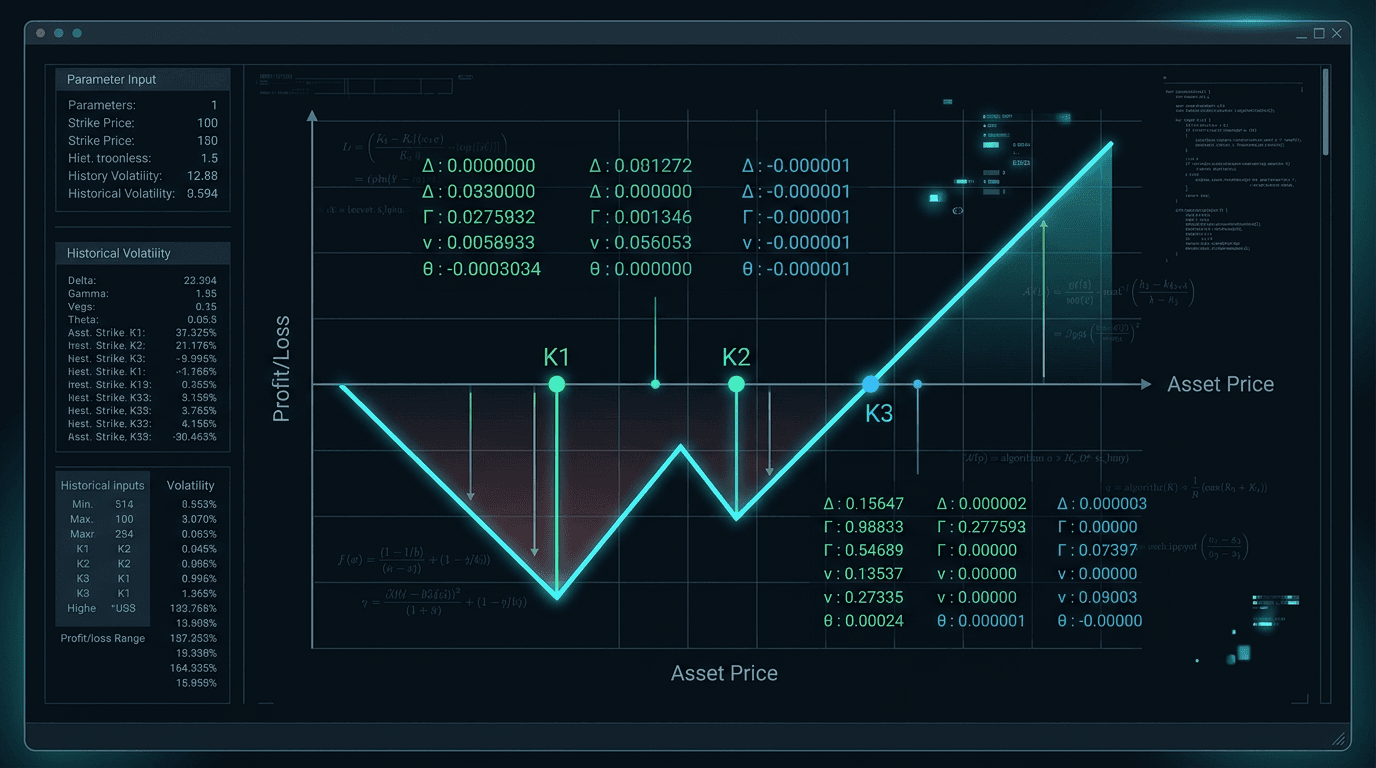
Why Most Butterfly Traders Leave Money on the Table
You set up a standard butterfly spread. Three strikes, symmetrical wings, limited risk on both sides. The position bleeds theta, you collect a small credit, and you pray the underlying stays pinned at your middle strike through expiration.
Then volatility spikes. The stock gaps through your upside break-even. You lose the same amount you risked on the downside—except the stock moved up, not down. You paid for protection you didn't need.
The broken wing butterfly fixes this. You shift one wing farther out-of-the-money, creating asymmetric risk. You define exactly where you expect the stock NOT to go, eliminate wasted premium on that side, and collect a larger credit upfront. The trade becomes directional without losing the butterfly's core structure.
What you'll learn:
- Strike selection formulas for broken wing butterflies with directional bias
- How to calculate max loss, break-evens, and credit collection for asymmetric setups
- Python code to model Greeks and P&L curves for any underlying
- When to use broken wing vs standard butterfly vs strangle strategy
- Real parameter choices for SPY, AAPL, and high-IV underlyings in 2026
- Common setup errors that turn small edges into account-draining losses
What Is a Broken Wing Butterfly?
A broken wing butterfly is a four-leg options spread where you buy one option at a middle strike, sell two options at a second strike, and buy one option at a third strike—but the third strike is NOT equidistant from the second. You break the symmetry, moving one wing farther out-of-the-money.
The standard butterfly is a neutral strategy. You sell two at-the-money calls, buy one call below, buy one call above. Risk is capped on both sides. The broken wing version removes risk on one side entirely or reduces it to near-zero, creating a directional tilt.
Call broken wing butterfly (bullish tilt):
- Buy 1 call at strike A (lower)
- Sell 2 calls at strike B (middle)
- Buy 1 call at strike C (upper, farther from B than A is from B)
Put broken wing butterfly (bearish tilt):
- Buy 1 put at strike A (upper)
- Sell 2 puts at strike B (middle)
- Buy 1 put at strike C (lower, farther from B than A is from B)
The asymmetry shifts your risk profile. If you widen the upper wing on a call butterfly, you reduce upside risk and increase downside risk. You're betting the stock won't rally past your upper strike but might drift down. You collect a net credit or pay a smaller debit than a standard butterfly.
Strike Selection: The Distance Formula
The key to a broken wing butterfly is the ratio between wing widths. For a standard butterfly, both wings are equal: if strike B is $5 above strike A, strike C is $5 above strike B. For a broken wing, you widen one side.
Call broken wing (bullish):
- A = current price - X
- B = current price
- C = current price + 2X (or more)
Put broken wing (bearish):
- A = current price + X
- B = current price
- C = current price - 2X (or more)
The multiplier (2X vs 3X vs 1.5X) determines how much risk you shift. A 2:1 ratio is the most common. If you buy the $100 call, sell two $105 calls, and buy the $115 call, your upper wing is twice as wide as your lower wing. You've eliminated most upside risk. If the stock rallies past $115, your long call offsets one of the short calls, and the spread behaves like a vertical spread above $115.
Credit vs debit:
- If you widen the wing opposite your directional bias, you collect a credit. A bullish broken wing call butterfly with a wide upper wing generates a credit because you're selling more premium than you're buying.
- If you widen the wing in the direction of your bias, you pay a debit (rare setup, used when you want a small credit butterfly with a skewed profit zone).
Most traders use the credit version. You want to get paid to take on the risk you're willing to accept.
P&L Calculation: Max Profit, Max Loss, Break-Evens
The math for a broken wing butterfly is the same as a standard butterfly, except one wing has a different width.
Max profit: occurs at the middle strike (B) at expiration. All options expire worthless except the short strikes, which you sold. Max profit = credit received (if credit spread) or (narrow wing width - debit paid) if debit spread.
Max loss (downside for call butterfly, upside for put butterfly): occurs when the stock moves past the narrow wing. Max loss = narrow wing width - credit received.
Max loss (opposite side): if the stock moves past the wide wing, the spread behaves like a vertical. Max loss = wide wing width - narrow wing width - credit received. In a true broken wing, you set the wide wing far enough out that this loss is zero or near-zero.
Break-even points:
- Lower break-even (call butterfly): A + credit received
- Upper break-even (call butterfly): solve for the point where the spread's value equals the credit received. For a 2:1 ratio, it's often near B + (narrow wing width) + credit.
Example: SPY call broken wing butterfly (SPY at $450):
- Buy 1x $445 call @ $8.00
- Sell 2x $450 calls @ $5.50 each = $11.00 credit
- Buy 1x $460 call @ $2.00
Net credit: $11.00 - $8.00 - $2.00 = $1.00
- Narrow wing width: $450 - $445 = $5
- Wide wing width: $460 - $450 = $10
Max profit: $1.00 credit (at $450 at expiration)
Max loss (downside): $5 - $1.00 = $4.00 (if SPY closes below $445)
Max loss (upside): $10 - $5 - $1.00 = $4.00 (if SPY closes above $460)
Lower break-even: $445 + $1.00 = $446
Upper break-even: $450 + $4.00 = $454
This setup is neutral-to-slightly-bullish. You profit if SPY stays between $446 and $454. You lose $4.00 on either side, but the upside break-even is farther out, reflecting the wider upper wing.
Python Code: Modeling Broken Wing Butterfly P&L
This script calculates P&L and Greeks for a broken wing call butterfly. Adjust strikes and premiums for any underlying.
import numpy as np
import matplotlib.pyplot as plt
from scipy.stats import norm

def black_scholes_call(S, K, T, r, sigma):
    d1 = (np.log(S / K) + (r + 0.5 * sigma**2) * T) / (sigma * np.sqrt(T))
    d2 = d1 - sigma * np.sqrt(T)
    return S * norm.cdf(d1) - K * np.exp(-r * T) * norm.cdf(d2)

def broken_wing_butterfly_pnl(S, A, B, C, premium_A, premium_B, premium_C):
    """
    S: underlying price at expiration
    A: lower strike (long 1 call)
    B: middle strike (short 2 calls)
    C: upper strike (long 1 call)
    premiums: entry prices paid/received
    """
    long_A = np.maximum(S - A, 0) - premium_A
    short_B = -(np.maximum(S - B, 0) - premium_B) * 2
    long_C = np.maximum(S - C, 0) - premium_C
    return long_A + short_B + long_C

# Parameters: SPY at $450, 30 DTE, 20% IV
S0 = 450
A, B, C = 445, 450, 460
premium_A = 8.0
premium_B = 5.5
premium_C = 2.0
net_credit = 2 * premium_B - premium_A - premium_C

# P&L at expiration
prices = np.linspace(430, 470, 200)
pnl = [broken_wing_butterfly_pnl(p, A, B, C, premium_A, premium_B, premium_C) for p in prices]

# Plot
plt.figure(figsize=(10, 6))
plt.plot(prices, pnl, label='Broken Wing Butterfly P&L', linewidth=2)
plt.axhline(0, color='gray', linestyle='--', linewidth=0.8)
plt.axvline(S0, color='blue', linestyle='--', linewidth=0.8, label='Current Price')
plt.axvline(B, color='red', linestyle='--', linewidth=0.8, label='Max Profit Strike')
plt.xlabel('SPY Price at Expiration')
plt.ylabel('Profit / Loss ($)')
plt.title('Broken Wing Call Butterfly: SPY 445/450/460')
plt.legend()
plt.grid(alpha=0.3)
plt.show()

print(f"Net Credit: ${net_credit:.2f}")
print(f"Max Profit (at {B}): ${net_credit:.2f}")
print(f"Max Loss (downside): ${(B - A) - net_credit:.2f}")
print(f"Max Loss (upside): ${(C - B) - (B - A) - net_credit:.2f}")
Run this with your broker's mid-prices. Adjust A, B, C for different underlyings. The plot shows the asymmetric payoff curve—steeper loss on the narrow wing, flatter on the wide wing.
Broken Wing Butterfly vs Standard Butterfly vs Strangle
| Feature | Standard Butterfly | Broken Wing Butterfly | Strangle Strategy |
|---|---|---|---|
| Structure | Symmetrical wings | One wing wider | Two legs only (call + put) |
| Directional bias | Neutral | Slight directional tilt | Neutral or directional |
| Max profit | At middle strike | At middle strike | Unlimited (if underlying moves far) |
| Max loss | Equal on both sides | Asymmetric (smaller on wide wing) | Unlimited (short strangle) or premium paid (long strangle) |
| Credit/debit | Usually debit | Usually credit | Credit (short) or debit (long) |
| Theta | Positive near middle strike | Positive near middle strike | Negative (long) or positive (short) |
| Best for | Low IV, tight range | Moderate IV, suspected direction | High IV, expecting big move or no move |
The broken wing butterfly sits between a standard butterfly and a strangle strategy. You get the capped risk of a butterfly but the directional edge of a skewed setup. You collect more credit than a standard butterfly because you're selling more premium on the side you think won't be tested.
If you're bullish on SPY but not aggressively so, a broken wing call butterfly with a wide upper wing lets you profit from a slow grind higher while protecting against a sharp selloff. A short strangle has unlimited risk on both sides. A standard butterfly pays you less because you're buying equal protection on both wings.
When to Use a Broken Wing Butterfly
1. You have a directional bias but want capped risk.
You think AAPL will drift higher over the next 45 days, but you don't want to buy a naked call. A broken wing call butterfly with a wide upper wing gives you bullish exposure with defined downside risk.
2. Implied volatility is moderate to high.
Broken wings work best when IV is elevated enough that you can collect a meaningful credit. If IV is too low, the premiums on the short strikes won't cover the cost of the long strikes, and you'll pay a debit. Target IV rank above 40 or IV percentile above 50.
3. You want to reduce capital requirements vs a vertical spread.
A bull call spread on SPY from $450 to $455 costs $5.00 per contract (minus the credit from the short call). A broken wing butterfly with the same lower strikes but a wider upper wing costs less or generates a credit, while still giving you exposure to upward movement.
4. You're hedging a long stock position.
If you own 100 shares of TSLA at $250 and expect it to stay range-bound or drift slightly higher, you can sell a broken wing put butterfly below your entry. You collect a credit, profit if TSLA stays above $240, and limit your downside if it drops to $230.
5. Earnings or event plays.
If you think a stock will move but not past a certain level, a broken wing butterfly captures the move without paying for protection on the side you don't expect. Example: NVDA earnings. You think it rallies to $520 but not past $530. Sell a broken wing call butterfly: buy $510, sell two $520, buy $535. You profit if NVDA closes between $510 and $525, and your upside risk is minimal if it blows past $530.
Strike Selection for High-IV vs Low-IV Underlyings
High-IV underlyings (IV rank > 60):
- Widen the wing opposite your bias by 2x to 3x. The inflated premiums on the short strikes let you collect a larger credit.
- Example: TSLA at $250, IV rank 70. Sell a broken wing put butterfly: buy $260 put, sell two $250 puts, buy $230 put. You collect $2.50 credit. Max profit $2.50 at $250. Max loss $7.50 if TSLA drops below $230.
Low-IV underlyings (IV rank < 40):
- Use a 1.5x to 2x wing ratio. Premiums are smaller, so you can't widen the wing as much without paying a debit.
- Example: SPY at $450, IV rank 30. Sell a broken wing call butterfly: buy $445, sell two $450, buy $457.50. Collect $0.50 credit. Narrow profit zone, but risk is still capped.
Days to expiration:
- 30–45 DTE is optimal. Theta decay accelerates in the final 30 days, but you have enough time for the stock to settle into your profit zone.
- Avoid <21 DTE unless you're trading a weekly event. Gamma risk increases, and small moves can swing P&L dramatically.
- Avoid >60 DTE. Theta decay is too slow, and you tie up capital for minimal credit.
Greeks: Delta, Gamma, Theta, Vega
A broken wing butterfly has different Greek exposure than a standard butterfly because of the asymmetry.
Delta: near-zero at entry if the middle strike is at-the-money. As the stock moves toward the narrow wing, delta becomes negative (for a call butterfly) or positive (for a put butterfly). The position acts like a short vertical spread if the stock moves past the narrow wing.
Gamma: positive near the middle strike, negative near the wings. If the stock sits at your short strikes, you want it to stay there. If it moves toward a wing, gamma works against you, accelerating losses.
Theta: positive near the middle strike. You profit from time decay if the stock stays in your profit zone. Theta peaks around 21 DTE. If the stock moves to a wing, theta turns negative because the long options decay slower than the short options.
Vega: near-zero at entry if wings are balanced. If you widen the upper wing on a call butterfly, you have slight negative vega (you profit if IV drops). If you widen the lower wing, slight positive vega. In practice, vega is small enough to ignore unless IV swings 10+ points.
Example: SPY 445/450/460 broken wing call butterfly, SPY at $450, 30 DTE:
- Delta: +0.02 (near-neutral)
- Gamma: +0.05 (positive near $450)
- Theta: +$8 per day (positive, peaks at 21 DTE)
- Vega: -$2 per 1% IV change (slightly negative because upper wing is wider)
If SPY stays at $450, you collect $8/day in theta. If SPY drops to $445, delta goes negative, and you start losing. If IV spikes, vega works against you, but the effect is small.
Setting Up a Broken Wing Butterfly in Your Broker
Most brokers classify broken wing butterflies as "custom spreads" or "unbalanced butterflies." You'll need Level 3 or Level 4 options approval.
Step-by-step (example: Thinkorswim):
- Open the option chain for your underlying.
- Select the expiration (30–45 DTE recommended).
- Right-click the lower strike call (A) → Buy.
- Right-click the middle strike call (B) → Sell → Quantity 2.
- Right-click the upper strike call (C) → Buy.
- Verify the net credit/debit. Adjust strikes if needed.
- Set the order as a limit order at the mid-price or better.
- Confirm max profit, max loss, break-evens before submitting.
Order entry tips:
- Use a limit order. Market orders on multi-leg spreads get filled at terrible prices.
- Start at the mid-price. If no fill after 30 seconds, move your limit toward the natural price by $0.05 increments.
- Avoid trading in the first 15 minutes after open. Spreads are wide, and you'll overpay.
- Check the bid-ask spread on each leg. If the spread is >$0.20 per contract, liquidity is poor. Consider a different underlying or expiration.
Managing the Position: When to Close or Roll
Close at 50% max profit:
If you collected a $1.00 credit and the position is worth $0.50 with 15 DTE remaining, close it. You've captured half the profit in half the time. Theta decay slows after 21 DTE, and gamma risk increases. Take the win.
Close if the stock moves past the narrow wing:
If SPY drops to $443 in the example above (lower break-even is $446), you're approaching max loss. Close the position. Don't wait for expiration hoping for a bounce. Gamma will work against you, and a further move amplifies losses.
Roll the position if the stock drifts toward the wide wing:
If SPY rallies to $458 with 10 DTE remaining, you're near the upper break-even. You have two choices:
- Close the position and take the small loss.
- Roll the entire spread up by $5. Close the 445/450/460 butterfly, open a 450/455/465 butterfly. You collect additional credit and reset your profit zone around the new price.
Rolling works if you still believe the stock will stay range-bound. Don't roll if the stock is trending hard in one direction.
Let it expire if the stock is near the middle strike:
If SPY is at $450 with 1 DTE remaining, let the position expire. The short calls will expire worthless, and you keep the full credit. Monitor after-hours movement—if SPY gaps past your upper strike after hours, you could be assigned on the short calls.
Common Mistakes That Turn Small Edges Into Losses
1. Setting the wide wing too close.
If you widen the upper wing to only 1.5x the lower wing, you haven't shifted enough risk. The stock can easily move past your upper break-even, and you lose on both sides. Use a 2:1 ratio minimum. For high-IV underlyings, 3:1 is better.
2. Trading illiquid underlyings.
If the bid-ask spread on each leg is $0.30 or more, you're paying $0.90+ in slippage on a four-leg spread. That's 90% of your credit on a $1.00 butterfly. Stick to liquid underlyings: SPY, QQQ, AAPL, TSLA, NVDA, MSFT. Avoid low-volume stocks with wide spreads.
3. Ignoring gamma risk near expiration.
If you hold a broken wing butterfly into the final week, gamma explodes. A $2 move in the underlying can swing your P&L by $100+ per contract. Close or roll by 7 DTE unless you're comfortable with the risk.
4. Using broken wings in low-IV environments.
If IV rank is below 30, the premiums on your short strikes are too small. You'll collect a $0.25 credit on a $5-wide butterfly, and a $1 move against you wipes out the profit. Wait for IV rank above 40 or use a different strategy like a vertical spread.
5. Forgetting to account for commissions.
A four-leg spread costs $0.65 to open and $0.65 to close on most brokers ($0.65 per contract per leg). If you collect a $1.00 credit, commissions eat 13% of your profit. Factor this into your break-even calculations. Consider brokers with flat-rate options pricing if you trade multi-leg spreads frequently.
6. Overleveraging.
A broken wing butterfly has capped risk, but "capped" doesn't mean "small." If your max loss is $4.00 per contract and you trade 20 contracts, you're risking $8,000. Size your position so max loss is 2–5% of your account. Don't treat capped risk as license to oversize.
Pro Tips: Advanced Parameter Choices
1. Use a 3:1 ratio for earnings plays.
If you expect a stock to move but not gap past a certain level, widen the wing opposite your bias to 3x. Example: AAPL earnings, stock at $180. You think it rallies to $185 but not past $190. Buy $175 call, sell two $180 calls, buy $195 call. You collect a larger credit and eliminate upside risk entirely.
2. Combine with a short put vertical for a "double broken wing."
If you're bullish, sell a broken wing call butterfly above the current price and a short put vertical below. You collect credit on both sides. Risk is capped below your put vertical and above your call butterfly. This setup works in moderate-IV environments when you expect a slow grind higher.
3. Adjust strikes based on expected move.
Most brokers show the "expected move" for an upcoming expiration (calculated from straddle prices). If the expected move for SPY is ±$10, set your narrow wing at $5 (half the expected move) and your wide wing at $15 (1.5x the expected move). This ensures your profit zone captures the most likely outcomes.
4. Use weekly expirations for event-driven setups.
If you're trading around FOMC, CPI, or earnings, use the weekly expiration immediately after the event. You capture the IV crush without holding through multiple weeks of theta decay. Close the position the day after the event if the stock is in your profit zone.
5. Monitor skew before entering.
If put skew is steep (OTM puts are expensive relative to calls), a put broken wing butterfly will cost more to enter. Check the skew chart in your broker. If skew is flat, broken wings are easier to set up for a credit. If skew is steep, consider a call broken wing instead.
Automating Broken Wing Butterflies with AI Agents
Setting up a broken wing butterfly manually requires monitoring IV rank, calculating strike distances, and timing entries around expected moves. You can configure an agent in Agentic Traders to scan for setups that meet your criteria—IV rank above 50, 30–45 DTE, and a 2:1 wing ratio—then execute the four-leg order when your target underlying hits a specific price level. The agent monitors the position, closes at 50% max profit or max loss, and logs every adjustment for post-trade analysis. You define the rules once, and the agent handles execution across multiple underlyings simultaneously.
FAQ
Q: Can I lose more than my max loss on a broken wing butterfly?
No, if you set it up correctly. Your max loss is defined by the narrow wing width minus the credit received. The only exception is if you're assigned early on the short strikes (rare, happens if the underlying pays a dividend or if the options are deep ITM). Use European-style options (SPX, RUT) to eliminate early assignment risk.
Q: How is a broken wing butterfly different from an iron condor?
An iron condor has four different strikes and uses both calls and puts. A broken wing butterfly uses three strikes and only calls (or only puts). The iron condor profits from range-bound movement on both sides. The broken wing butterfly has a directional tilt and shifts risk to one side.
Q: Should I use calls or puts for a broken wing butterfly?
Use calls if you're bullish or neutral-to-bullish. Use puts if you're bearish or neutral-to-bearish. The choice depends on your directional bias and which side you want to widen. If you widen the upper wing on a call butterfly, you're saying "I don't think the stock will rally past this level." If you widen the lower wing on a put butterfly, you're saying "I don't think the stock will drop past this level."
Q: What happens if the stock closes exactly at the middle strike?
You keep the full credit. All options expire worthless. This is max profit. If the stock closes $0.01 above or below, the P&L changes slightly, but you're still near max profit.
Q: Can I trade broken wing butterflies in an IRA?
Yes, if you have Level 3 options approval. Broken wing butterflies are defined-risk spreads, so most brokers allow them in retirement accounts. Check with your broker—some require Level 4 for unbalanced spreads.
Putting It All Together
A broken wing butterfly is a directional butterfly spread with asymmetric risk. You widen one wing to shift risk away from the side you don't expect the stock to move toward. You collect a larger credit than a standard butterfly, define your max loss on both sides, and profit from theta decay if the stock stays in your profit zone.
The setup requires precision. Strike selection, wing ratios, and IV rank determine whether you collect a credit or pay a debit. The Greeks shift as the stock moves, and gamma risk accelerates near expiration. Close at 50% max profit, roll if the stock drifts toward the wide wing, and size your position so max loss is 2–5% of your account.
Broken wing butterflies work best in moderate-to-high IV environments when you have a directional bias but want capped risk. They're more forgiving than naked options, more profitable than standard butterflies, and more capital-efficient than vertical spreads. If you're trading around earnings, FOMC, or expected moves, this is the strategy that captures the edge without exposing you to unlimited risk.
Related Articles
- Long Butterfly Option Strategy: Setup, Greeks & Profit Zones
- Best Option Trading Strategy: 7 Proven Setups for 2026
- Selling Options for Income: 7 Strategies That Generate Cash Flow
- Jade Lizard Option Strategy: Setup, Risk Profile & Profit Zones
Test this strategy with an AI agent at https://app.agentictraders.io/login—configure your strike selection rules, IV thresholds, and exit conditions, then let the agent monitor and execute across multiple underlyings while you focus on the next setup.
Continue reading
Jade Lizard Option Strategy: Setup, Risk Profile & Profit Zones
Master the jade lizard option strategy: a neutral-to-bullish credit spread with no upside risk. Learn strike selection, margin, Greeks, and when to deploy this income play.
StrategiesOption Trading for Beginners: The Complete 2026 Guide (PDF Alternative)
Learn option trading from scratch with real examples, code, and strategy setups. Better than any PDF—actionable, updated for 2026, with automated execution tips.
StrategiesSelling Options for Income: 7 Strategies That Generate Cash Flow
Master selling options for income with premium collection strategies, risk management, and automation. Learn covered calls, cash-secured puts, spreads, and AI execution.
StrategiesLong Butterfly Option Strategy: Setup, Greeks & Profit Zones
Master the long butterfly option strategy with strike selection, breakeven math, and volatility timing. Includes Python code, profit tables, and AI agent configuration.
Run this strategy with an AI agent.
Configure indicators, set rules, paper-trade for free. Your agent watches the charts so you don't have to.
Launch Terminal❯❯❯