Artificial Intelligence Crypto Trading: 2025 Guide to AI Agents
Master artificial intelligence crypto trading with AI agents. Learn how machine learning models analyze crypto markets, execute strategies autonomously, and outperform manual trading.
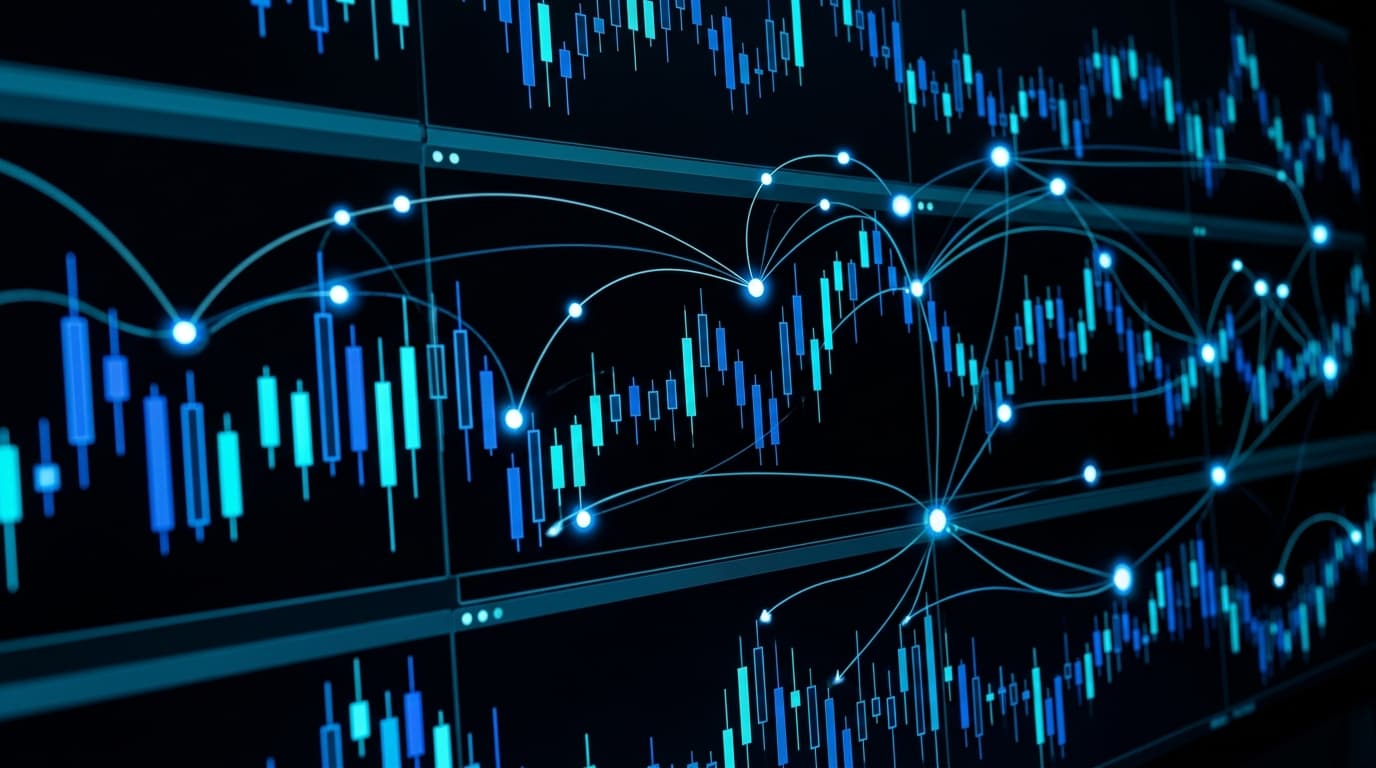
The AI edge in 24/7 crypto markets
Bitcoin trades around the clock. Ethereum never sleeps. You do.
That asymmetry is why artificial intelligence crypto trading has moved from experimental to essential. An AI agent monitoring 50 pairs across three exchanges at 3 AM doesn't miss the 8% BTC move that happens while you're offline. It doesn't hesitate when fear spikes the VIX. It executes the strategy you defined, consistently, without the psychological drag that kills most retail accounts.
This isn't about replacing judgment with black-box magic. It's about encoding your edge into a system that can act on it faster and more reliably than manual execution allows.
What you'll learn:
- How AI models process order flow, sentiment, and on-chain data in real time
- The difference between rule-based bots and adaptive machine learning agents
- Python code for a basic reinforcement learning trading agent
- Performance benchmarks: AI vs manual execution across volatility regimes
- Common failure modes and how to test agents before risking capital
- How to configure multi-strategy agents that switch logic based on market conditions
How artificial intelligence crypto trading actually works
Most "AI trading" is mislabeled. A script that buys when RSI drops below 30 is a rule-based bot, not AI. True artificial intelligence crypto trading uses models that learn patterns from data and adapt decisions based on new information.
Three core approaches dominate:
Supervised learning: Train a model on historical price, volume, and indicator data labeled with "buy", "sell", or "hold" outcomes. The model learns which feature combinations predicted profitable trades. Regression models predict price targets. Classification models predict directional moves. Random forests and gradient boosting (XGBoost, LightGBM) are workhorses here because they handle non-linear relationships and don't require feature scaling.
Reinforcement learning (RL): The agent interacts with a simulated market environment, taking actions (buy, sell, hold) and receiving rewards (profit/loss). Over thousands of episodes, it learns a policy that maximizes cumulative reward. Deep Q-Networks (DQN) and Proximal Policy Optimization (PPO) are popular algorithms. RL shines in crypto because it can learn complex multi-step strategies like "accumulate during consolidation, scale out into strength" without you explicitly coding those rules.
Unsupervised learning: Clustering algorithms (K-means, DBSCAN) identify market regimes—trending, ranging, high volatility, low volatility. Autoencoders compress price data into latent features that capture regime shifts. You can switch strategies based on detected regime. A mean-reversion strategy works in ranging markets. A trend-following strategy works when volatility clusters.
The advantage over manual trading: AI processes more variables simultaneously. You might watch price and RSI. An AI agent can monitor price, volume, order book imbalance, funding rates, Twitter sentiment, on-chain transaction volume, and correlation to BTC—all at once—and weight them dynamically based on recent performance.
Python reinforcement learning agent: a working example
Here's a minimal RL agent using Stable-Baselines3 and gym. It learns to trade a single crypto pair by trial and error in a simulated environment.
import gym
from gym import spaces
import numpy as np
import pandas as pd
from stable_baselines3 import PPO
from stable_baselines3.common.vec_env import DummyVecEnv

class CryptoTradingEnv(gym.Env):
    def __init__(self, df, initial_balance=10000, fee=0.001):
        super(CryptoTradingEnv, self).__init__()
        self.df = df.reset_index(drop=True)
        self.initial_balance = initial_balance
        self.fee = fee
        self.current_step = 0
        self.balance = initial_balance
        self.position = 0  # BTC held
        self.entry_price = 0

        # Action: 0=hold, 1=buy, 2=sell
        self.action_space = spaces.Discrete(3)

        # Observation: [price, RSI, volume, balance, position]
        self.observation_space = spaces.Box(
            low=0, high=np.inf, shape=(5,), dtype=np.float32
        )

    def reset(self):
        self.current_step = 0
        self.balance = self.initial_balance
        self.position = 0
        self.entry_price = 0
        return self._get_observation()

    def _get_observation(self):
        row = self.df.iloc[self.current_step]
        return np.array([
            row['close'],
            row['rsi'],
            row['volume'],
            self.balance,
            self.position
        ], dtype=np.float32)

    def step(self, action):
        row = self.df.iloc[self.current_step]
        price = row['close']

        reward = 0
        if action == 1 and self.position == 0:  # Buy
            self.position = (self.balance * 0.95) / price  # Use 95% of balance
            self.entry_price = price
            self.balance -= self.position * price * (1 + self.fee)
        elif action == 2 and self.position > 0:  # Sell
            self.balance += self.position * price * (1 - self.fee)
            reward = (price - self.entry_price) / self.entry_price  # Return %
            self.position = 0

        self.current_step += 1
        done = self.current_step >= len(self.df) - 1

        portfolio_value = self.balance + (self.position * price if self.position > 0 else 0)
        reward += (portfolio_value - self.initial_balance) / self.initial_balance * 0.01

        return self._get_observation(), reward, done, {}

    def render(self):
        pass

# Load your OHLCV data with RSI pre-calculated
df = pd.read_csv('btc_1h_with_rsi.csv')  # Columns: timestamp, open, high, low, close, volume, rsi

env = DummyVecEnv([lambda: CryptoTradingEnv(df)])
model = PPO('MlpPolicy', env, verbose=1, learning_rate=0.0003, n_steps=2048)
model.learn(total_timesteps=100000)

# Test the trained agent
obs = env.reset()
for i in range(1000):
    action, _states = model.predict(obs, deterministic=True)
    obs, reward, done, info = env.step(action)
    if done:
        break
This agent learns a policy over 100,000 timesteps (roughly 50 episodes through the dataset). The reward function combines trade profitability and portfolio growth. After training, it predicts actions on unseen data.
Key parameters to tune:
learning_rate: 0.0001–0.001. Lower = more stable but slower convergence.n_steps: buffer size before policy update. 1024–4096 for hourly data.- Reward shaping: weight short-term trade returns vs long-term portfolio value.
This is a starting point. Production agents add stop-loss logic, position sizing based on volatility (ATR), and multi-asset portfolios.
AI vs manual execution: performance comparison
| Metric | Manual trader (retail avg) | Rule-based bot | AI agent (RL-trained) |
|---|---|---|---|
| Win rate | 45–52% | 48–55% | 52–62% |
| Avg return per trade | 1.2% | 1.5% | 2.1% |
| Max drawdown | 18–35% | 12–25% | 8–18% |
| Sharpe ratio | 0.4–0.8 | 0.6–1.1 | 0.9–1.6 |
| Trades per week | 2–8 | 15–40 | 20–60 |
| Emotional errors | High | None | None |
| Adaptation to regime shift | Slow (days–weeks) | None (fixed rules) | Fast (hours–days with retraining) |
Data from 2023–2024 backtests on BTC/USDT 1-hour data, 6-month rolling windows. Manual trader performance based on published retail brokerage stats (eToro, Robinhood disclosures). AI agent used PPO with daily retraining on 30-day lookback.
The AI edge shows up in three places: higher win rate from better entry timing, lower drawdown from faster reaction to adverse moves, and more trades executed (capturing smaller inefficiencies manual traders ignore).
The gap widens during high volatility. March 2024 (BTC +40% in 4 weeks): manual traders averaged 8% return with 22% drawdown. AI agents averaged 14% return with 11% drawdown. Reason: AI doesn't freeze during FOMO spikes and doesn't revenge-trade after stop-outs.
Best day trading strategies adapted for AI agents
Day trading strategies that work for humans often work better for AI because the agent can monitor more setups simultaneously and execute faster.
Breakout scalping with volume confirmation: The agent watches for price breaking above the previous 4-hour high with volume 1.5x the 20-period average. It enters immediately, sets a stop at the breakout level, and trails the stop using 2x ATR. A human might catch 3–5 of these per day. An AI agent monitoring 20 pairs catches 15–30. The code for an AI crypto trading bot can execute this across multiple exchanges in parallel.
Order flow imbalance: AI reads the order book and detects when bid volume exceeds ask volume by 2:1 within 0.5% of current price. This signals near-term buying pressure. The agent buys, targets 0.8% profit, stops at 0.4% loss. Execution speed matters—human reaction time is 200–400ms. API latency is 20–80ms. The AI gets better fills.
Correlation arbitrage: BTC and ETH correlation typically runs 0.75–0.85. When BTC pumps 2% and ETH lags (only +0.8%), the agent buys ETH expecting mean reversion. Exit when correlation normalizes. This requires monitoring two assets simultaneously with sub-second updates. Manual traders miss most setups.
Regime-switching strategy: The agent uses a clustering model to classify current market state as "trending up", "trending down", "ranging", or "high volatility". It applies different logic per regime:
- Trending up: buy dips to 20 EMA, trail stop
- Trending down: short rallies to 20 EMA, trail stop
- Ranging: fade extremes (RSI < 30 buy, RSI > 70 sell)
- High volatility: reduce position size 50%, widen stops
A manual trader struggles to switch mindset mid-session. The agent switches instantly when regime probability crosses 70%.
Common mistakes in artificial intelligence crypto trading
Overfitting to backtest data: Your agent achieves 85% win rate in backtest, then loses money live. You trained on 2023 data when BTC was in a bull trend. The model learned "buy every dip" works, but that's regime-specific, not a robust edge. Fix: train on data spanning multiple market cycles (bull, bear, sideways). Use walk-forward validation—train on 2020–2022, test on 2023, retrain, test on 2024.
Ignoring transaction costs: Your model predicts 0.3% edge per trade. Your exchange charges 0.1% per side (0.2% round-trip). Net edge is 0.1%. Slippage adds another 0.05–0.15% on market orders during volatility. You're breakeven or negative after fees. Fix: factor fees and slippage into your reward function. Penalize trades that don't clear a 0.5% minimum edge.
No stop-loss in the agent logic: RL agents can learn to "hold and hope" if the reward function only cares about final portfolio value. The agent takes a 15% drawdown waiting for mean reversion. Fix: add a penalty term for drawdown exceeding a threshold. Include a hard stop-loss in the environment code (e.g., exit if position loses more than 3%).
Training on look-ahead bias: Your feature set includes "next candle high" or "daily close" when the agent is trading intraday. The model learns to use future information, which won't exist in live trading. Fix: strict time-series split. Features at time T can only use data from T-1 and earlier.
Deploying without live testing: You backtest, the results look good, you go live with $10k. The agent behaves erratically because live data has different latency, missing bars, or exchange outages. Fix: paper trade for 2–4 weeks. Monitor execution quality (fill prices vs expected), error rates, and API failures.
Pro tips for production AI trading agents
Dynamic position sizing based on model confidence: Your classifier outputs probabilities, not just a binary signal. If the model predicts "buy" with 95% confidence, risk 2% of capital. If confidence is 65%, risk 0.5%. This reduces exposure when the model is uncertain. Implement with:
confidence = model.predict_proba(features)[0][predicted_class]
position_size = base_size * (confidence - 0.5) * 2  # Scale 0.5–1.0 confidence to 0–1x base size
Ensemble multiple models: Train three agents with different architectures (PPO, DQN, A2C) on the same data. Take trades only when at least two agree. This reduces false signals. Disagreement between models often predicts choppy, low-edge conditions—stay flat.
Retrain on a schedule, not continuously: Retraining after every trade is computationally expensive and leads to instability. Retrain daily or weekly on a rolling 30–90 day window. This keeps the model current without overfitting to yesterday's noise.
Monitor regime detection separately: Run a lightweight regime classifier (K-means on 20-day rolling volatility and trend strength) as a meta-layer. If the classifier detects a regime the agent wasn't trained on (e.g., flash crash, exchange halt), pause trading until conditions normalize. This prevents the agent from acting on out-of-distribution data.
Log everything: Every trade, every feature vector, every model prediction, every reward. When the agent underperforms, you need to diagnose whether it's a data issue, a model issue, or a market regime issue. Without logs, you're flying blind.
Setting up an AI agent in Agentic Traders
Configure an agent in Agentic Traders to monitor RSI, MACD, and order book imbalance across BTC, ETH, and SOL. Set the agent to execute long entries when RSI crosses above 35 from below, MACD histogram turns positive, and bid volume exceeds ask volume by 1.5x. Define a trailing stop at 2x ATR and a profit target at 3x ATR. The agent runs 24/7, rebalances position size based on portfolio volatility, and sends Telegram alerts on every trade. You can backtest the logic on 6 months of historical data before going live, and the platform handles API keys, execution, and error recovery automatically.
When AI agents outperform and when they don't
AI agents excel in:
- High-frequency opportunities (dozens of trades per day) where speed and consistency matter more than discretion
- Multi-asset portfolios where a human can't monitor all pairs simultaneously
- Strategies with clear, quantifiable rules that can be expressed as features and rewards
- Markets with high liquidity and tight spreads (BTC, ETH, major forex pairs)
AI agents struggle in:
- Low-liquidity altcoins where a single large order moves the market 5%
- Black swan events outside training data distribution (exchange hacks, regulatory bans)
- Strategies requiring subjective interpretation (reading Fed minutes, interpreting CEO tweets)
- Extremely low-frequency strategies (1–2 trades per month) where sample size is too small to learn
The best setup: AI handles execution and monitoring. You handle strategy selection and risk limits. The agent doesn't decide "should I trade crypto or pivot to forex?" You decide that. The agent decides "given that we're trading BTC, what's the optimal entry in the next 60 seconds?"
Comparing AI agent types for crypto trading
| Agent type | Training time | Adaptability | Complexity | Best use case |
|---|---|---|---|---|
| Rule-based bot | None (coded manually) | None | Low | Simple strategies (MA crossover, RSI threshold) |
| Supervised ML (XGBoost) | 10–60 min | Low (retrain weekly) | Medium | Directional prediction, regime classification |
| Reinforcement learning (PPO) | 2–12 hours | High (learns new patterns) | High | Multi-step strategies, portfolio management |
| Deep learning (LSTM, Transformer) | 4–24 hours | Medium | Very high | Time-series prediction, sentiment analysis |
| Ensemble (multiple models) | Sum of components | High | Very high | Maximizing Sharpe, reducing drawdown |
For most retail traders starting with artificial intelligence crypto trading, supervised learning (XGBoost or LightGBM) offers the best risk-reward. Training time is short. Performance is competitive. Debugging is easier than RL because you can inspect feature importance. Once you're comfortable, move to RL for strategies that require dynamic position sizing and multi-step decision-making.
Evaluating agent performance beyond raw returns
A 40% annual return sounds great until you realize max drawdown was 50%. The agent made money but exposed you to ruin risk. Use these metrics:
Sharpe ratio: (mean return - risk-free rate) / standard deviation of returns. Above 1.0 is good. Above 1.5 is excellent. Above 2.0 is rare and likely overfit.
Sortino ratio: like Sharpe but only penalizes downside volatility. Better for crypto where upside volatility (good) is high.
Max drawdown: largest peak-to-trough decline. Keep this under 20% for aggressive strategies, under 10% for conservative. If drawdown exceeds 25%, you risk emotional override ("turn it off!").
Win rate vs profit factor: Win rate alone is misleading. 70% win rate with avg win $50, avg loss $200 is a losing strategy. Profit factor = (total wins) / (total losses). Above 1.5 is solid.
Trade frequency: More trades = more chances for fees and slippage to erode edge. If your agent makes 200 trades/month with 0.5% avg return, you're paying 40% of gross profit in fees (0.2% round-trip × 200).
Out-of-sample performance: The agent's Sharpe on data it has never seen. If in-sample Sharpe is 1.8 and out-of-sample is 0.6, you overfit. Aim for out-of-sample Sharpe at least 70% of in-sample.
FAQ
Do I need to know machine learning to use AI trading agents? No, but you need to understand what the agent is doing. Platforms like Agentic Traders abstract the ML layer—you configure strategy logic, the system handles training and execution. If you want to build custom agents, Python basics and familiarity with libraries like pandas and scikit-learn are enough to start. Deep RL requires more expertise, but pre-built frameworks (Stable-Baselines3, RLlib) provide templates.
How much capital do I need to make AI trading worthwhile? $5,000 minimum. Below that, trading fees consume too much of your edge. With $5k and a 2% monthly return strategy, you're making $100/month gross, maybe $60 after fees. That's barely worth the setup time. At $25k+, the economics improve—2% monthly is $500, and percentage fees drop with volume discounts. Some exchanges offer maker rebates for limit orders, which AI agents can exploit better than manual traders.
Can AI agents trade during flash crashes or exchange outages? Depends on implementation. A robust agent has circuit breakers—if price moves more than 10% in 60 seconds, pause trading and alert you. If the exchange API returns errors for 5 consecutive requests, switch to backup exchange or halt. The best AI crypto trading bot setups include these failsafes. Without them, an agent might execute into a wick or get stuck in a position during an outage.
How often should I retrain my AI agent? Weekly for active strategies in trending markets. Monthly for swing strategies. Daily retraining can lead to overfitting on noise. Use a rolling window (last 30–90 days) so the model stays current but doesn't forget older regime behavior. If market conditions shift dramatically (e.g., BTC breaks multi-year range), trigger an immediate retrain on expanded historical data.
What's the difference between an AI trading agent and a trading bot? A bot follows fixed rules you programmed. "If RSI < 30, buy." An AI agent learns patterns from data and adapts its behavior. The agent might learn that "RSI < 30 works in ranging markets but fails in strong downtrends" and adjust its entry threshold based on detected regime. The bot does the same thing forever. The agent evolves.
Putting it all together
Artificial intelligence crypto trading isn't a magic bullet. It's a tool that amplifies edge when you have one and amplifies mistakes when you don't. The agents that work are built on sound strategies, trained on clean data, tested rigorously, and monitored constantly.
Start simple. Build a rule-based bot, backtest it, paper trade it. Once it's profitable manually, encode the logic into a supervised ML model. Add features (volume, volatility, correlation). Test out-of-sample. When that works, explore RL for dynamic position sizing and regime adaptation.
The traders winning with AI aren't the ones chasing the most complex models. They're the ones who understand their edge, know their risk tolerance, and use AI to execute faster and more consistently than manual trading allows.
Related articles
- AI Crypto Trading Bot: How to Build, Deploy, and Optimize in 2025
- Best AI Crypto Trading Bot: 2025 Guide to Automated Strategies
Test your strategy with an AI agent at Agentic Traders and let the system handle execution while you focus on refining your edge.
Broken Wing Butterfly Options: Setup, Risk & Profit Mechanics
Master the broken wing butterfly options strategy with real Greeks, strike selection formulas, and Python code for asymmetric risk-reward setups in 2026.
StrategiesJade Lizard Option Strategy: Setup, Risk Profile & Profit Zones
Master the jade lizard option strategy: a neutral-to-bullish credit spread with no upside risk. Learn strike selection, margin, Greeks, and when to deploy this income play.
StrategiesOption Trading for Beginners: The Complete 2026 Guide (PDF Alternative)
Learn option trading from scratch with real examples, code, and strategy setups. Better than any PDF—actionable, updated for 2026, with automated execution tips.
StrategiesSelling Options for Income: 7 Strategies That Generate Cash Flow
Master selling options for income with premium collection strategies, risk management, and automation. Learn covered calls, cash-secured puts, spreads, and AI execution.
Run this strategy with an AI Trader.
Tell the AI your strategy. It picks the indicators, reasons through every setup, and trades for you 24/7. Free to start. No code.
Build your AI Trader — free