AI Crypto Trading Bot: How to Build, Deploy, and Optimize in 2025
Learn how AI crypto trading bots work, compare top platforms, and build your own automated strategy with Python code examples and real configuration tips.
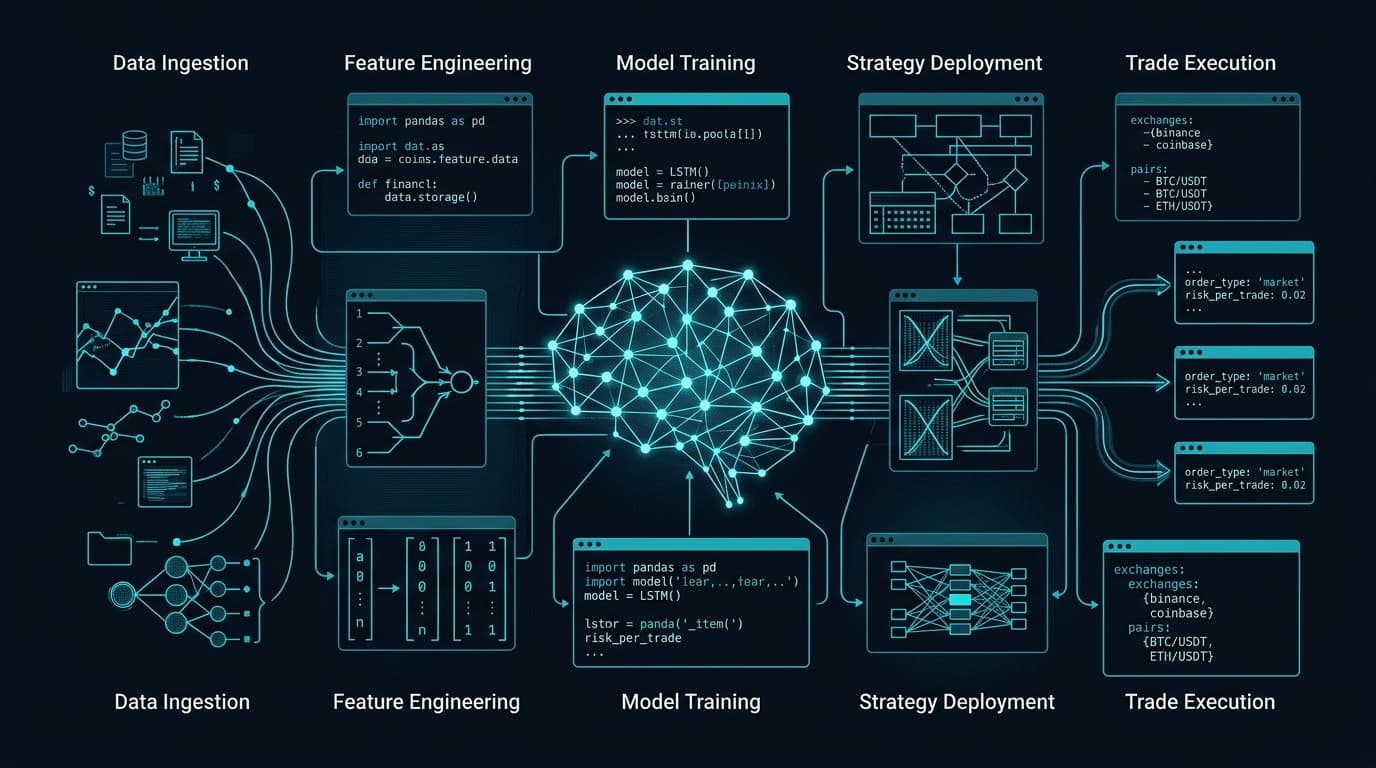
When automation meets volatile markets
You wake up at 3 AM to check your phone. Bitcoin dropped 8% while you slept, triggering the stop-loss you forgot to set. Your Discord is flooded with traders who caught the bounce at 2:47 AM and rode it back up 5%. They didn't stay awake. They used AI crypto trading bots that executed while they slept.
The promise is simple: algorithms that never sleep, never panic, and execute faster than any human. The reality is more nuanced. Most traders who deploy bots without understanding the mechanics lose money faster than manual trading. The difference between a profitable bot and an expensive mistake comes down to strategy design, risk parameters, and knowing what AI can and cannot do in crypto markets.
What you'll learn
- How AI crypto trading bots differ from rule-based algorithmic systems and where machine learning actually adds value
- The three core architectures (rule-based, ML-enhanced, and reinforcement learning) with real use cases for each
- Step-by-step Python code to build a basic momentum bot using CCXT and pandas
- Risk management parameters that prevent catastrophic drawdowns in 24/7 crypto markets
- How to evaluate bot performance beyond simple profit metrics
- Common failure modes that wipe out accounts and how to avoid them
The three types of crypto trading bots
Not all bots use AI. The term "AI crypto trading bot" gets thrown around for any automated system, but the architecture matters.
Rule-based bots execute predefined logic. If RSI drops below 30 on the 15-minute chart and volume exceeds the 20-period average by 1.5x, buy 2% of portfolio. No learning, no adaptation. These dominate retail crypto trading because they're predictable and debuggable. Most "AI bots" marketed to beginners are actually rule-based systems with a few moving averages.
ML-enhanced bots use machine learning for specific components. A random forest model might predict short-term volatility to adjust position sizes, while the entry and exit rules remain fixed. Or an LSTM network forecasts the next 4-hour price direction, but a traditional stop-loss still governs risk. Hybrid systems combine the interpretability of rules with ML pattern recognition.
Reinforcement learning bots treat trading as a sequential decision problem. The agent learns a policy by trial and error, maximizing cumulative reward (profit minus drawdown penalties). RL bots can discover non-obvious strategies, but they require massive computational resources and historical data. Most retail traders lack the infrastructure to train them properly.
For crypto specifically, ML-enhanced bots hit the sweet spot. Pure RL systems overfit to backtest data and fail in live markets. Rule-based bots can't adapt to regime changes (bull to bear, high to low volatility). A hybrid approach uses ML to detect market conditions and switches between rule sets accordingly.
Building a momentum bot with Python and CCXT
This example trades BTC/USDT on Binance using a simple momentum strategy: buy when the 20-period EMA crosses above the 50-period EMA on the 1-hour chart, sell on the reverse crossover. We'll add an ML component that predicts volatility and adjusts position size.
import ccxt
import pandas as pd
import numpy as np
from sklearn.ensemble import RandomForestRegressor
from datetime import datetime

# Initialize exchange
exchange = ccxt.binance({
    'apiKey': 'YOUR_API_KEY',
    'secret': 'YOUR_SECRET',
    'enableRateLimit': True,
})

def fetch_ohlcv(symbol='BTC/USDT', timeframe='1h', limit=200):
    """Fetch historical candlestick data"""
    ohlcv = exchange.fetch_ohlcv(symbol, timeframe, limit=limit)
    df = pd.DataFrame(ohlcv, columns=['timestamp', 'open', 'high', 'low', 'close', 'volume'])
    df['timestamp'] = pd.to_datetime(df['timestamp'], unit='ms')
    return df

def calculate_indicators(df):
    """Add EMAs and ATR for volatility"""
    df['ema_20'] = df['close'].ewm(span=20, adjust=False).mean()
    df['ema_50'] = df['close'].ewm(span=50, adjust=False).mean()

    # ATR for volatility prediction
    df['tr'] = np.maximum(
        df['high'] - df['low'],
        np.maximum(
            abs(df['high'] - df['close'].shift(1)),
            abs(df['low'] - df['close'].shift(1))
        )
    )
    df['atr'] = df['tr'].rolling(window=14).mean()

    return df

def train_volatility_model(df):
    """Train RF model to predict next-period ATR"""
    features = ['ema_20', 'ema_50', 'volume', 'atr']
    df['atr_next'] = df['atr'].shift(-1)
    df_train = df[features + ['atr_next']].dropna()

    X = df_train[features]
    y = df_train['atr_next']

    model = RandomForestRegressor(n_estimators=50, max_depth=5, random_state=42)
    model.fit(X, y)
    return model

def calculate_position_size(predicted_volatility, base_size=0.02, max_size=0.05):
    """Scale position size inversely with predicted volatility"""
    # Lower volatility = larger position, capped at max_size
    vol_factor = 1 / (1 + predicted_volatility)
    return min(base_size * (1 + vol_factor), max_size)

def execute_strategy():
    df = fetch_ohlcv()
    df = calculate_indicators(df)
    model = train_volatility_model(df)

    # Current market state
    current = df.iloc[-1]
    prev = df.iloc[-2]

    # Predict volatility for position sizing
    features = np.array([[current['ema_20'], current['ema_50'],
                          current['volume'], current['atr']]])
    predicted_vol = model.predict(features)[0]
    position_size = calculate_position_size(predicted_vol)

    # Signal logic
    cross_up = (prev['ema_20'] <= prev['ema_50']) and (current['ema_20'] > current['ema_50'])
    cross_down = (prev['ema_20'] >= prev['ema_50']) and (current['ema_20'] < current['ema_50'])

    balance = exchange.fetch_balance()
    usdt_balance = balance['USDT']['free']

    if cross_up and usdt_balance > 10:
        # Buy signal
        amount_usd = usdt_balance * position_size
        amount_btc = amount_usd / current['close']
        print(f"BUY: {amount_btc:.6f} BTC at {current['close']} (size: {position_size:.2%})")
        # exchange.create_market_buy_order('BTC/USDT', amount_btc)

    elif cross_down:
        # Sell signal
        btc_balance = balance['BTC']['free']
        if btc_balance > 0.0001:
            print(f"SELL: {btc_balance:.6f} BTC at {current['close']}")
            # exchange.create_market_sell_order('BTC/USDT', btc_balance)

# Run every hour
execute_strategy()
This bot does three things most retail bots don't: it adjusts position size based on predicted volatility, it uses a simple ML model that won't overfit (random forest with max depth 5), and it separates signal generation from execution so you can test logic before going live. The commented-out create_market_order lines prevent accidental execution while testing.
Risk parameters that actually matter in 24/7 markets
Crypto never closes. A bot running on Friday at 11 PM will execute through the weekend when liquidity drops and spreads widen. Traditional stock-trading risk rules break.
Max drawdown per trade: Set this as a percentage of portfolio, not a fixed dollar amount. A 2% stop-loss on a $10,000 account means risking $200 per trade. Recalculate after every trade. Most blown accounts came from fixed position sizes that didn't scale down after losses.
Daily loss limit: If the bot loses 5% of portfolio value in a single day, stop trading until manual review. Implement this as a circuit breaker in your code. Check total_loss_today before executing any new orders.
Maximum open positions: Crypto correlations spike during crashes. Bitcoin drops 10%, and 80% of altcoins drop 15%. Holding five uncorrelated positions in theory becomes five correlated losses in practice. Limit to 2-3 open trades unless you're trading across genuinely different asset classes (BTC, stablecoins, DeFi tokens with negative BTC correlation).
Slippage tolerance: Market orders on low-liquidity pairs can fill 3-5% worse than the last price. Set a maximum acceptable slippage (e.g., 0.5%) and use limit orders if the spread exceeds it. Your backtest assumed zero slippage. Live trading won't.
Funding rate awareness: Perpetual futures charge funding every 8 hours. A long position in a heavily shorted asset earns funding. A long in an overleveraged market pays funding that eats into profits. Check the current funding rate before entering positions that might hold overnight.
Here's a comparison of risk parameters across different account sizes:
| Account Size | Max Risk Per Trade | Daily Loss Limit | Max Open Positions | Slippage Tolerance |
|---|---|---|---|---|
| $1,000 | 1% ($10) | 3% ($30) | 1 | 0.8% |
| $10,000 | 2% ($200) | 5% ($500) | 2 | 0.5% |
| $50,000 | 2% ($1,000) | 5% ($2,500) | 3 | 0.3% |
| $100,000+ | 1.5% ($1,500) | 4% ($4,000) | 4 | 0.2% |
Smaller accounts need tighter risk controls because a single bad trade represents a larger percentage loss. Larger accounts can tolerate more open positions because they have capital to diversify, but per-trade risk should decrease as account size grows (counterintuitive but empirically proven).
Backtesting vs forward testing vs live trading
Your bot made 40% in backtest. It lost 12% in the first month live. This gap has three causes.
Lookahead bias: Your code calculated an indicator using data that wouldn't have been available at trade time. Example: using the daily close to generate a signal at 10 AM. Pandas makes this easy to screw up. Always use .shift(1) when referencing previous values, and never call .iloc[-1] on the current bar until it's closed.
Survivorship bias: Your backtest dataset included only coins that still exist. The 40% gain came partly from avoiding coins that went to zero, but your live bot can't predict which new coins will survive. Test on the full universe of tradable assets at each historical point, not just today's top 100.
Overfitting to regime: Crypto had a bull market from October 2023 to March 2024. A momentum bot trained on that data learned "buy dips, hold." When volatility spiked in April, the same bot held through 20% drawdowns. Test across multiple regimes: 2022 bear, 2023 chop, 2024 bull. If performance collapses in any regime, the strategy isn't robust.
Forward testing solves this. After backtesting on 2022-2023 data, run the bot on 2024 data without re-optimizing parameters. If it still works, deploy on paper trading (simulated execution with live data) for 2-4 weeks. Only after paper trading shows consistent results do you risk real capital.
The performance metrics that matter: Sharpe ratio (return per unit of volatility), max drawdown, win rate, and average win/loss ratio. A 60% win rate with 1:1 win/loss is worse than a 40% win rate with 3:1 because the latter survives losing streaks. Track these weekly and compare to backtest predictions.
When machine learning actually helps in crypto trading
ML is not magic. It's pattern recognition on historical data. Crypto markets have three properties that make ML useful and three that make it dangerous.
Where ML adds value:
-
Regime detection: Train a classifier on features like 30-day volatility, trading volume, and BTC dominance to label market states as "bull," "bear," "high volatility," or "low volatility." Switch between strategy rule sets based on the predicted regime. A random forest or gradient boosting model can achieve 70-75% accuracy on regime classification, which is enough to improve risk-adjusted returns.
-
Volatility forecasting: GARCH models and LSTMs predict short-term volatility better than historical averages. Use these predictions to scale position sizes (higher predicted vol = smaller positions) or adjust stop-loss distances (wider stops in high vol to avoid getting shaken out).
-
Anomaly detection: Autoencoders identify unusual market behavior (sudden volume spikes, order book imbalances, social sentiment shifts). These anomalies often precede large moves. An autoencoder trained on normal market data flags outliers, giving your bot a signal to tighten stops or take profits early.
Where ML fails:
-
Price prediction: Predicting whether BTC will be higher or lower in 4 hours is a coin flip. The market is too efficient. Hundreds of well-funded quant firms are already trading on any predictable pattern. Your LSTM trained on Binance data won't beat them.
-
Overfitting to noise: Crypto has short history (Bitcoin is 15 years old, most altcoins less than 5). Training a deep neural network on 3 years of data produces a model that memorized specific price patterns, not generalizable features. Simpler models (random forests, logistic regression) outperform in live trading.
-
Ignoring market structure: ML models treat price as a time series. They don't understand order book depth, funding rates, or whale wallet movements. A model might predict a bullish move right as a whale dumps 500 BTC on the market. Combine ML with market microstructure data or don't use it at all.
For most retail traders, a rule-based bot with ML-enhanced position sizing and regime detection outperforms pure ML systems. The code example earlier showed this: fixed EMA crossover rules, ML-predicted volatility for position sizing.
Comparing crypto bot platforms and building your own
You can buy a pre-built bot, subscribe to a platform, or code your own. Each has trade-offs.
| Platform Type | Cost | Customization | Technical Skill Required | Typical Use Case |
|---|---|---|---|---|
| SaaS platforms (3Commas, Cryptohopper) | $20-100/month | Low (preset strategies) | None | Beginners, simple grid/DCA bots |
| Open-source frameworks (Freqtrade, Jesse) | Free (+ server costs) | High | Intermediate Python | Custom strategies, backtesting |
| Cloud bot builders (TradingView + webhooks) | $15-60/month | Medium (Pine Script) | Basic scripting | Indicator-based strategies |
| Fully custom (Python + CCXT) | Free (+ API costs) | Total | Advanced Python | Unique strategies, ML integration |
| Agentic platforms | Variable | High (natural language config) | Low to medium | Multi-asset, autonomous agents |
SaaS platforms work if you're running a grid bot or DCA (dollar-cost averaging) strategy. They handle API keys, execution, and basic risk management. You won't build anything novel, but you also won't accidentally lose your API keys in a GitHub repo.
Open-source frameworks like Freqtrade give you full control. You write strategies in Python, backtest on historical data, and deploy to a VPS. The learning curve is steep (expect 2-4 weeks to get comfortable), but you own the code and can integrate any ML model or data source.
Building from scratch with CCXT (the library in the earlier code example) is for traders who need something the frameworks can't do: custom order types, multi-exchange arbitrage, or integration with proprietary data feeds. You handle everything—API rate limits, error handling, logging, monitoring. Budget 40+ hours for a production-ready bot.
Agentic Traders sits between SaaS and custom. You configure an agent in natural language—"Monitor BTC/USDT on the 1-hour chart, buy when RSI drops below 30 and volume exceeds 1.5x the 20-period average, use 2% position size, stop-loss at 3% below entry"—and the platform generates the execution logic. The agent runs autonomously, adjusts to live market data, and logs every decision. You get customization without writing CCXT boilerplate. Useful for traders who know what they want but don't want to debug API errors at 2 AM.
Common mistakes that blow up crypto trading bots
Mistake 1: No emergency kill switch. Your bot enters a long position. The exchange API goes down. The bot can't fetch prices or place orders. It holds through a 30% crash because it doesn't know the crash is happening. Always implement an external monitor (a separate script or service) that checks if the bot is responsive and can manually close positions if the bot hangs.
Mistake 2: Testing on the same data used for optimization. You tweaked your EMA periods from 20/50 to 18/47 because 18/47 had higher backtest returns. You just overfit. The performance gain came from random noise, not a better strategy. Use walk-forward optimization: optimize on 2022 data, test on 2023, optimize on 2023, test on 2024. If performance degrades, the parameters don't generalize.
Mistake 3: Ignoring exchange fees and maker/taker differences. Binance charges 0.1% taker fees and 0.02% maker fees (with BNB discount). A bot that trades 10 times per day with market orders pays 1% daily in fees. A strategy with 0.8% daily expected return loses money after fees. Use limit orders where possible, factor fees into backtest calculations, and track fee costs separately from P&L.
Mistake 4: Running bots on your laptop. Your internet drops. Your laptop restarts for an update. The bot misses a stop-loss order and holds through a 15% loss. Deploy bots to a cloud VPS (AWS, DigitalOcean, Vultr) with 99.9% uptime. Cost is $5-20/month. Losing one trade because your laptop died costs more.
Mistake 5: No position size scaling after losses. Your bot loses 10% of portfolio in a week. It keeps trading with the same position size, now representing a larger percentage of the smaller portfolio. After three losing trades, you're risking 5% per trade instead of the original 2%. Recalculate position sizes after every trade based on current portfolio value, not starting capital.
Advanced configurations for different market conditions
A single strategy won't work in all conditions. Momentum bots profit in trending markets and lose in choppy ranges. Mean-reversion bots profit in ranges and lose in breakouts. The solution: detect the regime and switch strategies.
Regime detection with ATR and ADX: Calculate the 14-period ATR and 14-period ADX. If ATR is above its 50-period average and ADX > 25, the market is trending—run a momentum bot. If ATR is below average and ADX < 20, the market is ranging—run a mean-reversion bot. If ADX is between 20-25, stay flat or reduce position sizes.
Volatility-adjusted stop-losses: In low volatility (ATR < 1.5% of price), use tight stops (1.5x ATR below entry). In high volatility (ATR > 3% of price), use wide stops (2.5x ATR) to avoid getting stopped out by noise. Recalculate ATR every 4 hours and adjust open positions' stop-losses accordingly.
Correlation-based position limits: Before entering a new trade, check the correlation between the new asset and existing positions. If you're long BTC and considering ETH, and their 30-day correlation is 0.85, treat them as a single position for risk purposes. Don't open the ETH trade if it would exceed your max-risk limit when combined with BTC exposure.
Time-of-day filters: Crypto volume peaks during US and Asian trading hours (12 PM - 4 PM UTC and 12 AM - 4 AM UTC). Avoid trading during low-volume hours (6 AM - 10 AM UTC) when spreads widen and slippage increases. Add a time filter to your bot: only execute signals during high-volume windows.
Funding rate arbitrage: On perpetual futures, if the funding rate exceeds 0.1% every 8 hours (equivalent to 10% annualized), consider a cash-and-carry arbitrage: short the perpetual, long the spot, collect funding. This isn't directional trading, but it's a use case for bots that monitor funding rates across exchanges and execute when the spread justifies it.
Evaluating bot performance beyond profit
A bot made 15% in three months. Is that good? Depends on the risk taken and market conditions.
Sharpe ratio: Return divided by volatility (standard deviation of returns). A Sharpe above 1.5 is good for crypto. Above 2.0 is excellent. Below 1.0 means you're taking too much risk for the return. Calculate this on daily returns: (mean_daily_return / std_daily_return) * sqrt(365).
Max drawdown: The largest peak-to-trough decline. A bot with 15% return and 8% max drawdown is better than one with 20% return and 25% max drawdown. Drawdowns kill compounding. A 50% loss requires a 100% gain to recover. Track this daily and compare to backtest predictions. If live max drawdown exceeds backtest by 50%, something is wrong.
Win rate vs profit factor: Win rate is the percentage of profitable trades. Profit factor is total profit divided by total loss. A 40% win rate with a 2.5 profit factor (average win is 2.5x average loss) is sustainable. A 70% win rate with a 1.1 profit factor is fragile—one large loss wipes out many small wins.
Recovery time: After a drawdown, how many days until the bot reaches a new equity high? Faster recovery indicates resilience. If recovery takes longer than the drawdown period, the bot isn't adapting to changing conditions.
Correlation with BTC: If your altcoin bot has 0.95 correlation with BTC price, you're just leveraged BTC exposure. A good bot should have correlation below 0.6, indicating it's generating alpha, not just riding the market.
Track these metrics in a spreadsheet or database. Review weekly. If any metric degrades by more than 20% from backtest expectations for two consecutive weeks, pause the bot and investigate.
Handling API rate limits and exchange-specific quirks
Exchanges limit API requests to prevent abuse. Binance allows 1,200 requests per minute on the spot API. Exceed that, and you get IP-banned for an hour. Your bot needs to respect these limits.
Rate limiting in code: Use the enableRateLimit flag in CCXT (as in the earlier example). CCXT automatically throttles requests to stay under the exchange's limit. For custom implementations, add a sleep timer: time.sleep(0.1) between requests ensures you never exceed 10 requests per second.
Websocket vs REST: REST APIs are request-response. You ask for the current price, the exchange responds. Websockets stream data continuously. For real-time bots, connect to the exchange's websocket feed (e.g., Binance's wss://stream.binance.com) and receive price updates every 100ms without making repeated REST calls. This saves rate limit quota for order placement.
Order placement failures: APIs fail. The exchange times out, returns a 503 error, or rejects your order because the price moved. Wrap all order placement in try-except blocks and implement retries with exponential backoff. After three failures, log the error and alert you (email, Telegram bot, Discord webhook) instead of crashing.
Testnet vs mainnet: Most exchanges offer a testnet (sandbox environment with fake money). Binance Testnet, Bybit Testnet, etc. Deploy your bot to testnet first, let it run for a week, verify it places orders correctly and handles errors. Only after clean testnet operation do you switch to mainnet with real funds.
Exchange-specific fees: Binance, Coinbase, Kraken, and Bybit have different fee structures. Binance offers discounts for holding BNB. Kraken charges higher taker fees but lower maker fees. Your bot should fetch the fee schedule from the exchange API and factor it into profitability calculations. Don't hardcode fees—they change.
Pro tips from traders running bots for 2+ years
Tip 1: Log everything, then query logs. Every trade, every signal, every error. Store logs in a database (SQLite for small scale, PostgreSQL for production). When performance degrades, query the logs: "Show me all trades where slippage exceeded 0.5%" or "Show me signals that didn't execute because of API errors." You'll find patterns you'd miss in a spreadsheet.
Tip 2: Run multiple uncorrelated bots, not one complex bot. A momentum bot on BTC, a mean-reversion bot on ETH, and a funding arbitrage bot on perpetuals. Each has 5% expected monthly return and 0.3 correlation with the others. Combined, you get 15% return with lower drawdown than any single bot. Diversification works for strategies, not just assets.
Tip 3: Paper trade every parameter change for 100 trades before going live. You tweaked the RSI threshold from 30 to 35. That's a new strategy. Paper trade it. Changing one parameter can flip a profitable bot into a losing one because the parameter was optimized for past data, not future data.
Tip 4: Monitor your bot's latency. Measure the time between receiving a price update and placing an order. If latency exceeds 500ms, you're losing edge to faster bots. Optimize your code, move your server closer to the exchange (AWS us-east-1 for Coinbase, AWS ap-northeast-1 for Binance), or use a compiled language (Rust, C++) instead of Python for the execution loop.
Tip 5: Have a manual override ready. A hotkey or command that closes all positions and stops the bot. Market flash crashes happen. Your bot might not react fast enough. You need a way to exit everything in under 10 seconds. Practice using it so you don't fumble during an actual emergency.
Frequently asked questions
Do I need to know machine learning to run an AI crypto trading bot?
No. Most profitable bots use simple rule-based logic with basic statistical models. You need to understand moving averages, RSI, and position sizing more than you need to understand neural networks. If you want to add ML, start with a random forest for regime detection or volatility forecasting—these are interpretable and don't require deep learning expertise.
How much capital do I need to make a crypto trading bot worthwhile?
Minimum $1,000, realistically $5,000+. Below $1,000, exchange fees eat too much of your returns. At $1,000, a 2% monthly return is $20, minus $5-10 in fees, leaving $10-15. At $5,000, the same 2% is $100, and fees are proportionally smaller. Bots scale better with larger capital because fixed costs (server, data feeds) stay constant.
Can a bot trade multiple exchanges simultaneously?
Yes, but it's complex. You need to manage API keys for each exchange, handle different fee structures, and account for transfer times if arbitraging between exchanges. CCXT supports 100+ exchanges with a unified API, making multi-exchange bots feasible. Start with one exchange, prove profitability, then expand.
What happens if the bot loses my API keys or gets hacked?
Use API keys with restricted permissions. On Binance, create a key with "Enable Spot Trading" but NOT "Enable Withdrawals." A hacker can place trades but can't withdraw your funds. Store keys in environment variables, not hardcoded in scripts. Use a secrets manager (AWS Secrets Manager, HashiCorp Vault) for production bots.
How do I know if my bot is underperforming vs the market is just bad?
Compare your bot's returns to a buy-and-hold benchmark. If BTC dropped 20% this month and your bot lost 8%, the bot added value (it lost less). If BTC gained 15% and your bot gained 5%, the bot underperformed—you'd be better off holding. Track this ratio monthly. A good bot outperforms in down markets and keeps pace in up markets.
What to test next
You've built a basic bot or deployed a platform bot. Now test its limits.
Run it on historical data from 2022 (bear market), 2023 (choppy sideways), and 2024 (bull run). If it only works in one regime, it's not robust. Add regime detection and switch between momentum and mean-reversion logic based on ATR and ADX.
Simulate API failures. Modify your code to randomly reject 5% of orders and see if the bot recovers gracefully. Does it retry? Does it skip the trade? Does it crash? Production bots must handle errors without human intervention.
Track your bot's performance against a simple benchmark: 60/40 BTC/stablecoin rebalanced monthly. If your bot underperforms this passive strategy after fees, you're paying for complexity with no benefit. Simplify or abandon the strategy.
Test different position sizes. Run the same strategy with 1%, 2%, and 3% risk per trade. Measure how max drawdown and Sharpe ratio change. You'll find an optimal risk level—usually lower than you expect.
Broken Wing Butterfly Options: Setup, Risk & Profit Mechanics
Master the broken wing butterfly options strategy with real Greeks, strike selection formulas, and Python code for asymmetric risk-reward setups in 2026.
StrategiesJade Lizard Option Strategy: Setup, Risk Profile & Profit Zones
Master the jade lizard option strategy: a neutral-to-bullish credit spread with no upside risk. Learn strike selection, margin, Greeks, and when to deploy this income play.
StrategiesOption Trading for Beginners: The Complete 2026 Guide (PDF Alternative)
Learn option trading from scratch with real examples, code, and strategy setups. Better than any PDF—actionable, updated for 2026, with automated execution tips.
StrategiesSelling Options for Income: 7 Strategies That Generate Cash Flow
Master selling options for income with premium collection strategies, risk management, and automation. Learn covered calls, cash-secured puts, spreads, and AI execution.
Run this strategy with an AI Trader.
Tell the AI your strategy. It picks the indicators, reasons through every setup, and trades for you 24/7. Free to start. No code.
Build your AI Trader — free